Austerity in the UK: 2008-2013
By
Nicole Gelinas
City Journal, May-June 2013
Edited by Andy Ross
When the financial hurricane struck in 2008, Britain found itself in a
crisis. A giant credit bubble had fueled an unsustainable rise in the price
of real estate. When the bubble burst, British consumers stopped buying, the
UK lost 1.6% of its jobs, tax revenues slumped, and the budget deficit
expanded from 3.5% of GDP before the crisis to 11.5% in 2009.
David
Cameron ran for office in 2010, promising to tell the truth about the fiscal
mess and to take steps to clean it up. British voters gave his Conservative
party a plurality in Parliament, and the Liberal Democrats joined the party
in a coalition that came to power in May. But the coalition hasn't fixed the
fiscal mess, and public services are deteriorating fast.
In June
2010, UK chancellor of the exchequer George Osborne wanted to slash annual
spending by £40 billion to get Britain off the road to ruin. To avoid the
investor flight that would precipitate a public debt crisis, an austerity
budget was unavoidable. The solution was spending cuts. The goal was "an
economy where the state does not take almost half of all our national
income".
Osbone proposed an 80:20 rule of thumb. He planned to
take 77% of the reduction from the spending side and 23% from taxes. The
spending cuts would kick in much more slowly than the tax hikes. The
promised 77% wouldn't arrive for five years. But the tax slam came
immediately. Today taxpayers shoulder an annual burden 4.4% heavier than it was before
the coalition took power.
The coalition cut the corporate tax rate
for large companies by 4% to encourage firms to move jobs to the UK and to
discourage tax avoidance. They also increased the amount of money that
people could earn each year without paying income taxes, but raised VAT from
17.5% to 20% at the end of the year. Osborne: "The years of debt and
spending make this unavoidable."
Consumer spending had dropped by 2%
in 2009 and by another 1% in 2010. The higher VAT prolonged the slump.
Consumer spending fell by 1% in 2011 and remained flat in 2012. Because
retailing is a low-margin industry, a 2% loss in sales cuts profits by a
third, even if a retailer is operating efficiently. Between 2008 and 2012,
the retail industry lost 3.9% of its jobs.
A tax increase on the
wealthy failed to bring in the expected revenues. In early 2010, Osborne
waved through a plan to boost income taxes by 25% for people earning more
than £150,000 annually, for a top rate of 50%. It backfired. Wealthy people
avoided the levy. The coalition government had promised tax reform, but all
it has done with the code is confused tinkering.
The
coalition has been less draconian in cutting spending. The deepest austerity
in a generation led to a 4.7% spending increase relative to the previous
year, which exceeded the inflation rate. The budget for next year calls for
spending £672 billion, which is 44.4% of GDP and higher than this year's
43.1%. They didn't cut health care entitlements or challenge benefits for
the elderly.
Britain's £103 billion health care bill, nearly all of
which goes to the National Health Service (NHS), consumed almost one-sixth
of the government's total spending. To protect health care, Cameron and
Osborne forced harsher reductions onto the rest of the budget. The plan even
allows the NHS to keep growing. Making more room for it has eaten into
Britain's capital budget.
A second flaw in the coalition's
budget-cutting was that the government merely shifted some of its spending
burden onto local government. Because grants had constituted 55% of local
government spending, this meant whopping service cuts. Over the last three
years, local British governments have shuttered libraries, laid off workers,
and raised nuisance fees.
The cuts didn't help the budget situation
much. Since the coalition came to power, it has cut 554,000 government jobs,
8.8% of the previous total. The public sector workforce is now the same size
as it was in 2002. But spending hasn't fallen commensurately. Police numbers
are down by 10% but NHS ranks are steady. Spending on health care is still
rising.
Britain's economy hasn't turned around. Its GDP in 2012 was
2.3% smaller (after inflation) than it was in 2007. Last year, economic
growth was zero, inflation was well above the target of 2%, the unemployment
rate is just under 8%, and the threat of a new recession looms. The budget
outlook is still grim. Britons are tired of austerity. It will take a long
time to get out of this mess.
AR This is bleak. I was born under austerity in
the UK:
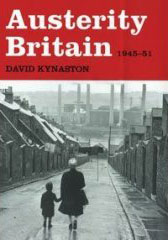
Austerity in the UK: 1945-1951
 |
Austerity Britain 1945-1951 |
This book charts the evolution of British society during the depleted and dingy years 1945–1951. As Britain shifted from desperate war to bankrupt peace, its Labour government set about building the first welfare state and attempting in myriad ways to uplift the country and its people.
 |
 |
| Austerity started as soon as the VE-Day parties were over | At least Brits had one day of pleasure between 1940 and 1950 |
Austerity meant a home front without a war. Food, clothing, and coal would now in some cases be even more sparingly apportioned than they had been when the war was on. With wit and ingenuity, Kynaston mines opinion surveys, radio shows, advertising slogans, parliamentary reports, and above all letters, diaries, and memoirs to evoke the gray tinge that permeated postwar life — the shabby frocks, the sallow faces, the grubby train compartments, the dreary meals.
 |
 |
| Some upper and middle class travelers flew in the Short Sandringham flying boat | Meanwhile working class Londoners enjoyed pub life as always |
Kynaston probes the personal and political clashes within the Labour Party
intelligentsia and recounts how women appropriated and adapted New Look
fashions. He analyzes labor-management relations in the British automotive
industry and traces the relationship between the decline in married
women's employment and changes in landscape design. He assesses the birth
and progress of the National Health Service and adumbrates the impact of
the hit BBC radio series Listen With Mother on a generation of children.
Kynaston recalls the peculiar tactile features — the "heavy coins, heavy
shoes, heavy suitcases, heavy tweed coats, heavy leather footballs" — that
make this recent past a foreign country.
Sports was one way out.
The record-breaking attendance figures for soccer, dog races, and speedway
no doubt signified the ascendancy of working-class culture in national life.
The audience for cricket, which appealed especially to the middle and upper
classes, also reached its apogee. Victorian seaside resorts as well as dance halls and picture
palaces were all at the peak of their popularity.
Kynaston imparts a sense
of the fortuitousness and richness of the everyday, with its jumble of
seismic and banal events, and he seems to relish smashing any tidy frame for
the story.
 |
 |
| HMS Vanguard was Britain's last battleship and was too late for war service | The Cunard liners Queen Elizabeth (docked) and Queen Mary (still in wartime gray) |
Again and again Kynaston reminds readers that the working class, which made
up 75 percent of the country, had never had it so good: its standard of
living was 10 percent higher in 1948 than a decade earlier, even as that of
the middle class declined by 20 percent. And for unskilled workers and the
unemployed, the mandated fairness of rationing ensured adequate food.
Moreover, the drab but nutritious rationed diet gave Britain the healthiest
people in its history.
More vividly and penetratingly than any
typical work of history, this book captures the rhythms and texture of
everyday life. To read it is to enter a world.
The voices of women
dominate this panoramic but fine-grained portrait of the quotidian.
Recurring references to the unpublished diaries of a dozen ordinary women
form the backbone of the book. Women experienced daily life much more
exquisitely than men, acutely analyzed and assimilated that experience, and
shrewdly, vividly, and precisely spoke and wrote about it.
 |
 |
| The first postwar HMS Ark Royal was launched in Birkenhead in 1950 | Avro Lancastrian freighters made from Lancaster bombers were used in the Berlin airlift |
The focus on women sheds light on the chasm between the intellectuals,
mandarins, and planners and those who were the object of their
ministrations. Long before its electoral victory in 1945, the Labour Party
had expanded its ranks to include an ascendant, brainy, progressive bunch.
Far more bent on cultural renewal than on economic or social egalitarianism,
this new group actually believed, as Deputy Prime Minister Herbert Morrison
said, that "part of our work in politics ... must be to improve human
nature."
The reformers were confronted with the most unpromising clay
to work with. Emerging from Kynaston's minute examination of the everyday is
the British people's profound social conservatism: its unshakable ability to
tune out all earnest discussion of politics and world affairs and stick to
talk about gardens and hemlines, its devotion to home and family.
 |
 |
| British Rail was nationalized and the locomotives were powered by coal | Utilities like gas were also nationalized and mostly powered by coal |
At war's end, Britain faced a housing crisis. German bombs had destroyed or
severely damaged 750,000 houses, and virtually no new ones had been built
for six years. In their diaries and letters as well as in survey after
survey, people made clear their dislikes in housing and their heart's
desire: a small suburban house with a garden. The planners and reformers
would have none of it.
Kynaston: Austerity Britain was a better place
for being a worse place. The better grew out of the worse, the worse out of
the better.
 |
 |
| The British film industry flourished with Ealing comedies like Kind Hearts and Coronets | The austerity era finally ended with the Coronation of Queen Elizabeth II |
 |
 |