The Brain Unveiled
By
Emily Singer
MIT Technology Review, November/December 2008
Edited by Andy Ross
1

2
3
Images by Van Wedeen, Ruopeng Wang, Jeremy Schmahmann, and Guangping Dai of
the MGH Martinos Center for Biomedical Imaging in Boston, MA; Patric Hagmann
of EPFL and CHUV, Lausanne, Switzerland; and Jon Kaas of Vanderbilt
University, Nashville, TN.
Brain Connections
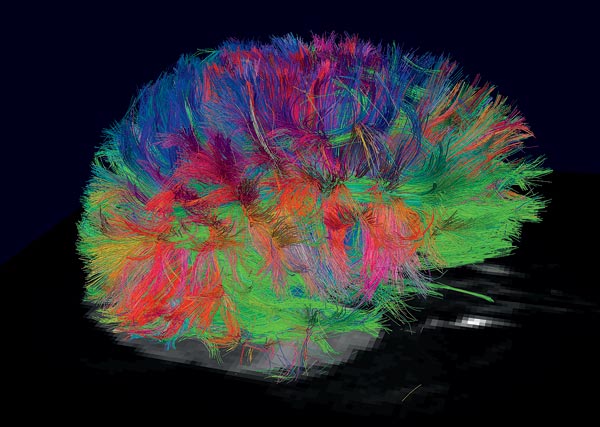
Diffusion spectrum imaging, developed by Van Wedeen at Massachusetts General
Hospital, analyzes magnetic resonance imaging (MRI) data in new ways,
letting scientists map the nerve fibers that carry information between
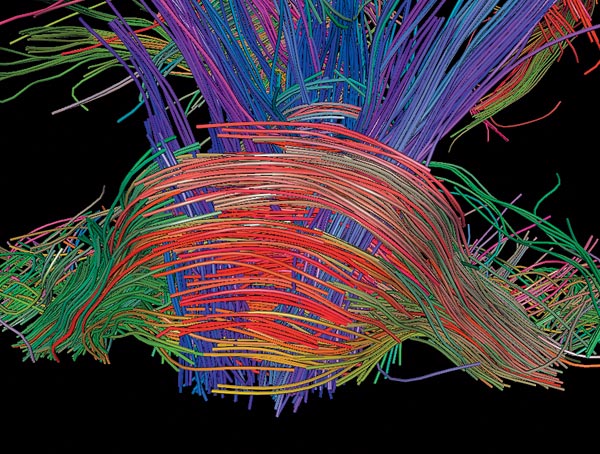
cells. These images, generated from a living human brain, show a
reconstruction of the entire brain (1) and a
subset of fibers (2). The red fibers in the
middle and lower left of both images are part of the corpus callosum
connecting the brain hemispheres.
Mapping Diffusion
Neural fibers in the brain are too tiny to image directly, so scientists map
them by measuring the diffusion of water molecules along their length. The
scientists first break the MRI image into voxels (3D pixels) and calculate
the speed at which water is moving through each voxel in every direction.
Then they can infer the most likely path of the various nerve fibers (red
and blue lines) passing through that spot. The result is a detailed diagram
like that of the brain stem (3).
Buffing the Brain
By Bryan Appleyard
The Sunday Times, November 16, 2008
Edited by Andy Ross
The brain is crème caramel mix of fat, water, and proteins. This is a
problem for baby-boomers. The selves they love are just so many crème
caramels soon to pass their sell-by date.
In the early 1990s, with
the development of magnetic resonance imaging (MRI), we found out how to
watch the brain at work. If MRI delivers half of what many people expect it
to deliver, these could turn out to be the most revolutionary machines in
human history.
Mark Jung Beeman, a professor of psychology at
Northwestern University in Illinois, is one of a group trying to understand
genius using MRI and EEG. There are two ways of solving problems: analytic
and inspirational. With analytic you just plod your way through the work,
reasoning your way to the solution. When you stop, new connections can be
formed. Finally you reach the eureka moment, you say "Aha!" and your problem
is solved.
Beeman: "Although all problem-solving relies on a largely
shared cortical network, the sudden flash of insight occurs when solvers
engage distinct neural and cognitive processes that allow them to see
connections that previously eluded them."
The process seems to be
centred on the anterior superior temporal gyrus. At Goldsmiths College in
London, Dr Joydeep Bhattacharya says the real issue is not the "Aha!" moment
itself, but the way it is produced in the brain: "We need to know the brain
processes involved, to find how this moment is strong enough to reach
consciousness. We know insight does not come from the sky."
There is
a link between musical improvisation and the "Aha!" moment. Improvisation is
found to be accompanied by a dissociated pattern of activity in the
prefrontal cortex. The prefrontal cortex is to the brain what a conductor is
to an orchestra. It pulls the whole show together.
The dissociated
pattern echoes the loosening of connections that precedes the "Aha!" moment.
Insight and creativity, perhaps even genius, seem to be linked to a brain
that can disorganise itself and freewheel, making new and unexpected
connections. Divergent thinkers habitually wander around their own minds,
looking for links, however absurd or surreal.
In 1788, one of the
greatest of all examples of divergent thinking came into the world. It was
Mozart's last symphony, the Jupiter.
There has always been a link
between madness and genius, and too much divergence can undoubtedly drive
you crazy. High creativity is not linked with schizophrenia but with mood
disorders — notably bipolar disorder or manic depression.
For a
boomer with brain rot, the short answer is use it or lose it. The plasticity
of the brain means that it is able, in the face of injury or decay, to find
ways of adapting itself to preserve strong patterns of activity. Read good
books — nothing works better.
In the end you die, and your crème
caramel dies with you. Mozart spent most of his 35 years giving the best
ever account in music of why your life is worth living.
A New Theory of Mental Disorders
By Benedict Carey
The New York Times, November 10, 2008
Edited by Andy Ross
Bernard Crespi, a biologist at Simon Fraser University in Canada, and
Christopher Badcock, a sociologist at the London School of Economics, have
published a theory of brain development that may change the way mental
disorders like autism and schizophrenia are understood.
Their idea is
that an evolutionary tug of war between genes from the father's sperm and
the mother's egg can tip brain development in one of two ways. A strong bias
toward the father pushes a developing brain along the autistic spectrum,
toward a fascination with objects, patterns, mechanical systems, at the
expense of social development. A bias toward the mother moves the growing
brain along a psychotic spectrum, toward hypersensitivity to mood,
increasing a child's risk of developing schizophrenia later on, or of mood
problems like bipolar disorder and depression.
Autism and
schizophrenia are at opposite ends of a spectrum that includes most
psychiatric and developmental brain disorders. Emotional problems like
depression, anxiety and bipolar disorder appear with schizophrenia on Mom's
side, while Asperger's syndrome and other social deficits are on Dad's.
The theory leans heavily on the work of David Haig of Harvard, who
argued in the 1990s that pregnancy was in part a biological struggle for
resources between the mother and unborn child. Natural selection should
favor mothers who limit the nutritional costs of pregnancy and have more
offspring, but it should also favor fathers whose offspring maximize the
nutrients they receive during gestation.
Evidence that this struggle
is being waged at the level of individual genes is accumulating. An
epigenetic effect changes the behavior of the gene without altering its
chemical composition. This occurs by muffling a gene with a marker that
makes it hard for the cell to read the genetic code.
To illustrate
how such genetic reshaping works, Crespi and Badcock point to a remarkable
group of children. Those with the genetic disorder called Angelman syndrome
typically have a jerky gait, appear unusually happy and have difficulty
communicating. Those born with a genetic problem known as Prader-Willi
syndrome often are placid and compliant as youngsters.
These two
disorders stem from disruptions of the same genetic region on chromosome 15.
If the father's genes dominate in this location, the child develops Angelman
syndrome. If the mother's do, the result is Prader-Willi syndrome. The
former is associated with autism, and the latter with mood problems and
psychosis later on, just as the new theory predicts.
 |
 |