International Thermonuclear Experimental Reactor
Shame on George W. Bush
By Andy Ross, for ITER
January 18, 2008
The USA has said it will suspend financial participation in the ITER
experimental fusion reactor project due to cuts in the federal research
budget. In its appropriations for fiscal 2008, Congress included only $10.7
million for US work on the project. The US financial commitment for ITER is
$1.1 billion, and the Bush administration had proposed spending $160 million
in 2008 to start purchasing components for the project.
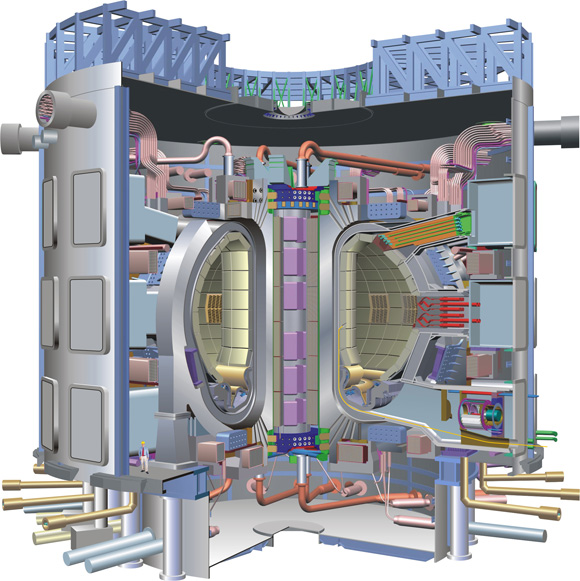
ITER is a joint
international research and development project that aims to demonstrate the
scientific and technical feasibility of fusion power. The partners in the
ITER project are the European Union (represented by EURATOM), Japan, the
People's Republic of China, India, the Republic of Korea, the Russian
Federation and the USA. ITER will be constructed in Europe, at Cadarache in
the South of France.
The long-term objective of fusion research is to
harness the nuclear energy provided by the fusion of light atoms to help
meet mankind's future energy needs. This research, which is carried out by
scientists from all over the world, has made tremendous progress over the
last decades. The fusion community is now ready to take the next step, and
have together designed the international ITER experiment. The aim of ITER is
to show fusion could be used to generate electrical power, and to gain the
necessary data to design and operate the first electricity-producing plant.
In ITER, scientists will study plasmas in conditions similar to those
expected in an electricity-generating fusion power plant. It will generate
500 MW of fusion power for extended periods of time, ten times more than the
energy input needed to keep the plasma at the right temperature. It will
therefore be the first fusion experiment to produce net power. It will also
test a number of key technologies needed for a real fusion
power station.
Fusion Power
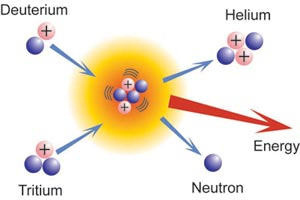
Fusion is the energy source of the sun and the
stars. In a fusion reaction, two light atomic nuclei fuse together to form
heavier ones. For example, one nucleus of deuterium and one of tritium fuse
together to form helium, a neutron, and a large amount of energy.
Fusion
has some key features which make it an attractive option in a future energy
mix:
#1 Fusion is an almost limitless energy supply. The basic fuels are distributed widely around the globe. Deuterium is abundant and can be extracted easily from sea water. Tritium can be produced from lithium, which is readily available in the Earth's crust.
#2 Fusion produces no greenhouse gas emissions. Fusion power plants will not generate gases such as carbon dioxide that cause global warming and climate change, nor other gases that have damaging effects on the environment.
#3 Fusion is suitable for the large-scale electricity production required for the increasing energy needs of large cities. A single fusion power station could generate electricity for two million households.
#4 Waste from fusion will not be a long-term burden on future generations. Only metal parts close to the fusion plasma will become radioactive. The radioactivity will decay over several decades and the metal can be reused after about 100 years.
#5 No transport of radioactive materials is required in the day-to-day operation of a fusion power station, as the intermediate fuel tritium is produced and consumed within the power plant.
#6 The fusion reaction is
inherently safe. Only about two grams of fuel is present in the plasma
vessel, enough for a few seconds of burn. As fusion is not a chain
reaction, the reaction can never run out of hand.
Ten Myths About Nuclear Power
By Rob Johnston
Spiked, January 9, 2008
Edited by Andy Ross
1 Uranium is running out
According to Greenpeace, uranium reserves are relatively limited and last
week the Nuclear Consultation Working Group claimed that a significant
increase in nuclear generating capacity would reduce reliable supplies from
50 to 12 years.
In fact, at current consumption levels, known uranium
reserves are predicted to last for 85 years. Geological estimates from the
International Atomic Energy Agency (IAEA) and the Organisation for Economic
Cooperation and Development (OECD) show that at least six times more uranium
is extractable, enough for 500 years' supply at current demand. Modern
reactors can use thorium as a fuel and convert it into uranium, and there is
three times more thorium in the ground than uranium.
Uranium is the
only fuel which, when burnt, generates more fuel. Not only existing nuclear
warheads, but also the uranium and plutonium in radioactive waste can be
reprocessed into new fuel.
There is more than enough uranium, thorium
and plutonium to supply the entire world's electricity for several hundred
years.
2 Nuclear is not a low-carbon option
Anti-nuclear campaigners claim that nuclear power contains hidden emissions
of greenhouse gases (GHGs) from uranium mining and reactor construction. But
so do wind turbines, built from huge amounts of concrete, steel and plastic.
The OECD analysed the total lifetime releases of GHG from energy
technologies and concluded that, taking into account mining of building
materials, construction and energy production, nuclear is still a
lower-carbon option than wind, solar or hydroelectric generation. During its
whole life cycle, nuclear power releases 3 to 6 grams of carbon per
kilowatt-hour (GC/kWh) of electricity produced, compared with 3 to 10 GC/kWh
for wind turbines, 105 GC/kWh for natural gas and 228 GC/kWh for lignite
(brown coal).
Greens, exemplified by the Sustainable Development
Commission, place their trust in carbon capture and storage (CCS) to reduce
the GHG emissions from coal and gas plants. But carbon capture is, at
present, a myth. There is no functioning power station with CCS in the
world, and if it did work, it would still greatly reduce the energy
efficiency of any power station where it is installed.
3 Nuclear power is expensive
With all power generation technology, the cost of electricity depends upon
the investment in construction (including interest on capital loans), fuel,
management and operation. Like wind, solar and hydroelectric dams, the
principal costs of nuclear lie in construction. Acquisition of uranium
accounts for only about 10 percent of the price of total costs, so nuclear
power is not as vulnerable to fluctuations in the price of fuel as gas and
oil generation.
A worst-case analysis conducted for the UK Department
of Trade and Industry (now the Department of Business and Enterprise), which
was accepted by Greenpeace, shows nuclear-generated electricity to be only
marginally more expensive than gas, and 10 to 20 times cheaper than onshore
and offshore wind. With expected carbon-pricing penalties for gas and coal,
nuclear power will be considerably cheaper than all the alternatives.
4 Reactors produce too much waste
Britain is not overwhelmed with radioactive waste. By 2040 there will be a
total of 2,000 cubic metres of the most radioactive high-level waste, which
would fit in a 13 x 13 x 13 metre hole, about the size of the foundations
for one small wind turbine. Much of this high-level waste is a leftover from
Britain's atomic weapons programme.
The largest volume of waste from
the nuclear power programme is low-level waste: concrete from outbuildings,
car parks, construction materials, soil from the surroundings, and so on.
Production of all the electricity consumed in a four-bedroom house
for 70 years leaves about one teacup of high-level waste, and new nuclear
build will not make any significant contribution to existing radioactive
waste levels for 20-40 years.
5 Decommissioning is too expensive
New reactors will be constructed from modular designs with the need for decommissioning built-in. The costs of decommissioning and waste management will be incorporated into the price of electricity to consumers. New nuclear plants are expected to have a working life of 40 years so the cost of decommissioning is spread over a long period.
6 Building reactors takes too long
This is perhaps the most ironic of the anti-nuclear arguments, since it is the opposition of greens that will cause most of the future delays. The Canadian company AECL has built six new reactors since 1991. From the pouring of concrete to coming online, the longest build took less than 7 years and the shortest just over 4 years.
7 Leukaemia rates are higher near reactors
Childhood leukaemia rates are no higher near nuclear power plants than they
are near organic farms. Leukaemia clusters are geographic areas where the
rates of childhood leukaemia appear to be higher than normal, but the
definition is controversial because it ignores the fact that leukaemia is
actually several very different diseases with different causes.
It is
purely by chance that a leukaemia cluster will occur near a nuclear
installation, a national park or a roller-coaster ride. Clusters tend to be
found in isolated areas where there has been a recent influx of immigration,
which hints at a virus.
Men who work on nuclear submarines or in
nuclear plants are no more likely to father children with leukaemia (or any
other disease) than workers in any other industry.
8 Reactors lead to weapons proliferation
More nuclear plants (in Britain and elsewhere) would actually reduce weapons proliferation. Atomic warheads make excellent reactor fuel; decommissioned warheads (containing greatly enriched uranium or plutonium) currently provide about 15 percent of world nuclear fuel. Increased demand for reactor fuel would divert such warheads away from potential terrorists.
9 Wind and wave power are more sustainable
Environmentalists claim offshore wind turbines can make a significant
contribution to electricity supply. Even if that were true, the
environmental impact disqualifies wind as sustainable. The opening up of the
North Sea continental shelf to 7,000 wind turbines is, essentially, the
building of a huge industrial infrastructure across a vast swathe of
ecologically sensitive seabed.
Wave power is still highly
experimental and unproven as a method of generating electricity. The cost
overruns and time delays would make any problems of the nuclear industry
look cheap by comparison.
10 Reactors are a terrorist target
Since 9/11, several studies have examined the possibility of attacks by a
large aircraft on reactor containment buildings. The US Department of Energy
sponsored an independent computer modeling study of the effects of a fully
fuelled Boeing 767-400 hitting the reactor containment vessel. Under none of
the possible scenarios was containment breached.
Only the highly
specialised US bunker-busting ordnance would be capable — after several
direct strikes — of penetrating the amount of reinforced concrete that
surrounds reactors. And terrorists have already demonstrated that they
prefer large, high visibility, soft targets with maximum human casualties
rather than well-guarded, isolated, low-population targets.
Edited by Andy Ross
A huge limestone pit in southern France will soon host a big ring of
burning plasma, an artificial sun ten times hotter than our real one. The
pit will hold ITER, the International Thermonuclear Experimental Reactor, a
collaboration between China, the European Union, India, Japan, South Korea,
Russia, and the United States.
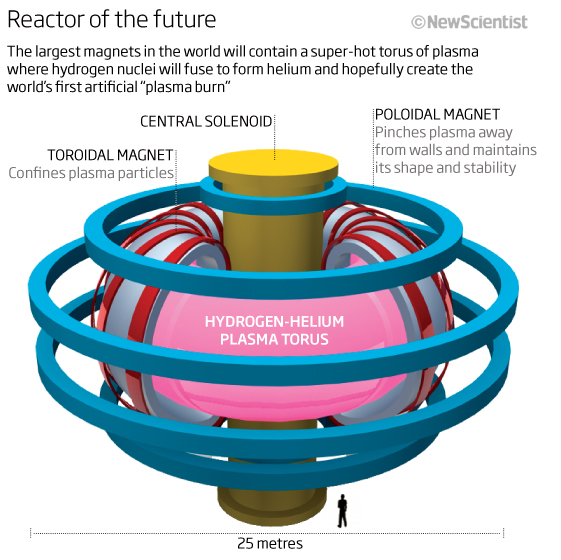
Nuclear fusion is the energy source of
the future. The heart of ITER will be a giant burning doughnut of ionized
hydrogen and helium at 150 million K. The plasma will burn deuterium and
tritium nuclei to form helium nuclei and spit out energetic neutrons that
heat the walls of the reactor. In future reactors the heat will drive a
turbine.
Containing the hot plasma means building several of the
largest magnets in the world. The magnets will be cooled to around 4 K to
become superconductors. Some of the coldest objects on the planet will be
just a few meters from one of the hottest things in the universe.
Fusion is much cleaner than fission. But it will still produce radioactive
and toxic materials. To deal with this, the designers are developing a
robotic system to remove and transport radioactive parts from the torus to a
storage room and replenish the torus with fresh parts. ITER operators will
use a VR system to control the robots.
MIT nuclear scientist Dennis Whyte: "We are basically making a star on the
planet."
Steve Connor
The Independent, April 27, 2013
A site in
Cadarache in southern France, the international thermonuclear experimental
reactor ITER is being built to show
how to make safe and sustainable
electricity via nuclear fusion. It could meet our energy needs and save the
planet.
This week saw approval of the fusion reactor blanket design.
ITER deputy director Carlos Alejaldre:
"We will have to show it is safe
... Any disturbance from ideal conditions and the reaction will stop.
A
runaway nuclear reaction and a core meltdown are simply not possible."
The ITER tokamak will be the first to generate more power than it
consumes. For every 50 MW of electricity its giant
electromagnets
consume, it should generate up to 500 MW of power output, as heat. When the
deuterium-tritium plasma fuel
is injected into the tokamak, the spinning
vortex will be heated up to 300 MK to form the inert gas helium as exhaust.
ITER may go nuclear soon after 2030.
 |
 |