NASA
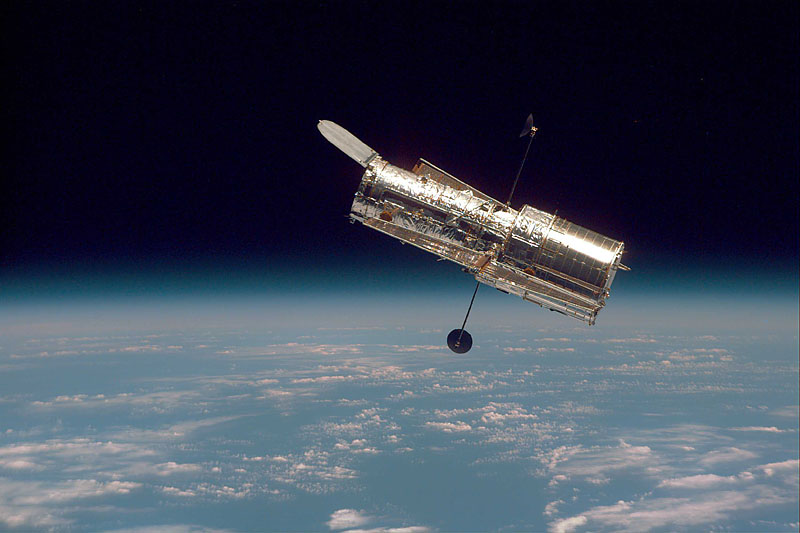
Hubble Space Telescope
NASA Finds More Planets
By
Marc Kaufman
Washington Post, March 24, 2008
Edited by Andy Ross
According to the
Extrasolar Planets Encyclopedia, there are now 277
confirmed "extrasolar" planets, and quite a few more on the list of those
suspected but not yet confirmed. This explosion in planetary discoveries is
taking place at such warp speed that even those most intimately involved are
often amazed -- especially because their ultimate goal is nothing less than
finding life elsewhere in the universe.
Mark Swain, of NASA's
Jet
Propulsion Laboratory, last week reported finding the first "exoplanet" to
have organic methane in its atmosphere. "We're not only finding them rapidly
and in great variety, but we're starting to characterize them — their mass
and orbits, the properties of their atmospheres, measurements of day and
night, dynamics of their winds."
So far, most of the faraway planets
are large, super-hot gas giants like Jupiter and Saturn, which are not
expected to be able to support life. But with astronomers regularly finding
ingenious ways to locate and examine distant planets — sometimes with new
technologies, sometimes because of inventive new ways of analyzing data --
many in the field say it is just a matter of time before they detect
Earth-size, rocky planets elsewhere in the cosmos.
Carl B. Pilcher,
director of the NASA Astrobiology Institute at the Ames Research Center in
California, agrees that the big challenge now is to detect smaller,
Earth-size planets, then to find more and better ways to learn about their
atmospheres and other characteristics. He said that just as the exoplanet
search has become supercharged of late, so, too, has the search for life on
other planets and in other solar systems, which is the primary focus of the
institute.
Some of the work of finding exoplanets and analyzing their
orbits and atmospheres is being done with ground-based telescopes, and some
from orbiting observatories such as the
Hubble Space Telescope, which
provided the data used to discover exoplanet methane. In addition,
astronomers and astrophysicists are developing ever more powerful ways to
interpret data and to use spectroscopy.
Considerably more powerful
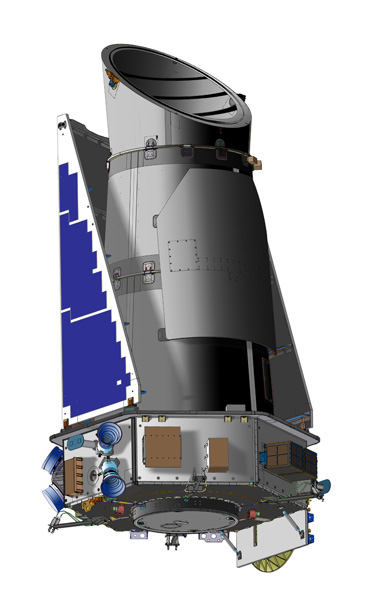
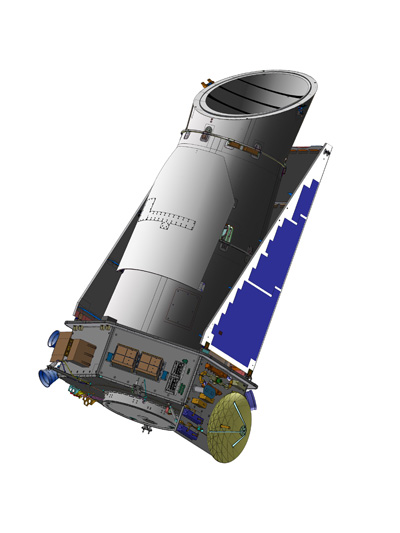
hardware is also on the way. NASA's
Kepler satellite, which is designed to
find distant planets as they transit in front of their stars, is supposed to
be launched next spring and is expected to locate hundreds or thousands of
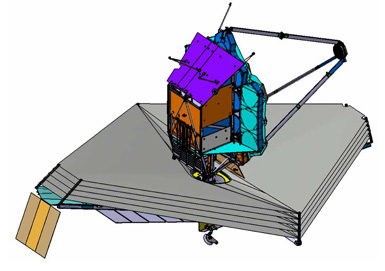
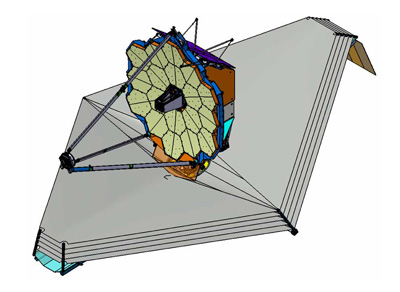
new planets. The James Webb Space Telescope, a Hubble successor that will be
able to find atmospheric molecules in rocky exoplanets, is scheduled for
launch in 2013.
 |
 |
 |
 |
Meanwhile, closer to home ...
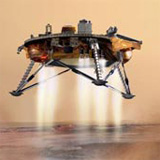
NASA's
Phoenix lander is scheduled to set down on the Northern plains of
Mars on May 25, 2008.
AR Wonderful stuff. Makes life worth living, just to see what all this new hardware discovers.

