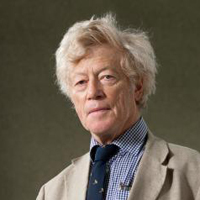
Sir Roger Scruton
1944−2020
Roger Scruton
By Melanie Phillips
The Times, January 14, 2020
Edited by Andy Ross
Sir Roger Scruton was Britain's greatest contemporary philosopher. The author of more than 50 books, he wrote about Kant and Wittgenstein, beauty and music,
architecture and sexual desire, fox-hunting and piety, art and the rural idyll.
Sir Roger articulated and championed the deep connections between conservatism, the English countryside and national identity. He recognised that without a
shared home and culture based on the inherited values, customs and laws of a nation state there can be no sense of "we" —
conservatism was about the defence of collective memory and freedom.
In his 2014 book
How to Be a Conservative, he recalled his astonishment when, witnessing the 1968 student riots in Paris, he realised that these radicals wanted to
destroy freedom in pursuit of Marxism. He concluded that the political alternative was conservatism. But when he started teaching at London
university, he discovered that all his colleagues opposed conservatism.
As the years went on, the totalitarian characteristics he had helped battle in eastern Europe surfaced in Britain under a different guise.
The universities started openly suppressing ideas.
AR I was personally acquainted with Scruton when I was a student and he was a young lecturer, when he seemed too archly Tory
to me. Since then, after reading the works of the philosopher Hegel, I have warmed to Scruton's brand of Conservatism.
The Sacred and the Human
By Roger Scruton
Prospect Magazine 137, August 2007
Edited by Andy Ross
Richard Dawkins, Christopher Hitchens and others caricature religion.
For Hegel, myths and rituals
are forms of self-discovery, through which we understand the place of the
subject in a world of objects, and the inner freedom that conditions all
that we do. The emergence of monotheism from the polytheistic religions of
antiquity is a form of self-creation, as the
spirit learns to overcome
its finitude.
Nietzsche and Wagner placed
the concept of the sacred at the centre of the anthropology of religion.
René Girard observes that religion has its roots in violence. Dawkins
and Hitchens conclude that religion is the cause of this violence and sexual
obsession. Girard argues that religion is not the cause of violence but the
solution to it.
Nietzsche envisages a primeval human society, reduced to near universal
slavery by the healthy egoists who impose their desires on others by the
force of their nature. The master race maintains its position by punishing
all deviation on the part of the slaves. The slave comes to think of his
condition as in some way deserved. For Nietzsche, this explains the entire
theological and moral vision of Christianity.
Girard sees the
primeval condition of society as one of conflict. In primitive societies, rivals
precipitate cycles of revenge. The solution is to identify a scapegoat.
According to Girard, the need for sacrificial scapegoating is implanted in
the human psyche.
Girard identifies Christ as a
victim who offers himself for sacrifice. The climax is the experience of sacred awe, as the victim forgives his tormentors. Christ's submission purified
society and religion of the need for sacrificial murder. For Girard, it is rightly thought of as a
redemption.
The experience of the sacred is a solution to the aggression in the heart of human communities. Birth, copulation and death are the moments when time
stands still and when we are apt to be filled
with awe. Religion begins from such moments.
AR (August 2007) Some 35 years
ago, when I was a graduate student of philosophy in London, I debated with
Roger, who was then a young lecturer. Still I debate mentally with his
writings. Half of what he says I like, half I feel the need to disown or
contradict. In this review, Roger finds an interesting kernel of truth about
Nietzsche and Wagner but seems to me to make too much of it. A Nietzschean
anthopology of religion covers Christianity and Judaism quite well, Islam
and Hinduism less well, and the more minor cults covered by people like
Pascal Boyer hardly at all. As for the Dawkins and Hitchens crowd, I suspect
they will remain unbowed by what looks almost like a work of Christian
apologetics.
Forgiveness and Irony
By Roger Scruton
City Journal, Winter 2009
Edited by Andy Ross
In the West today, citizenship is an order that confers security and freedom
in exchange for consent. Arab Muslims are apt to renounce not only freedom but also the idea of
citizenship.
Christianity has retreated. This retreat has left behind
it a sense of emptiness and defeat. It is hardly surprising that so many
Muslims in our cities today regard the civilization surrounding them as
doomed.
If repudiation of its past
and its identity is all that Western civilization can offer, it cannot
survive. But citizenship is an achievement that we cannot forgo if the
modern world is to survive. We should turn away from apologetic
multiculturalism.
A spirit of forgiveness upholds the core value of
citizenship and finds a path to social membership. Happiness comes from
sacrifice. And in the Judeo-Christian tradition, the primary act of
sacrifice is forgiveness.
The God of the Koran is not a lenient God. In His Koranic manifestation,
God forgives sparingly and with obvious reluctance. The Koran is no joke.
The ironic
temperament is a virtue. A habit of acknowledging the otherness of
everything sees that the one
who judges is also judged, and judged by himself.
A society that makes room for
forgiveness tends toward democracy. Irony amplifies this
democratic tendency.
Forgiveness and irony underlie our conception of
citizenship as founded in consent. This conception of law has little in
common with Muslim sharia, which is regarded as a system of commands issued
by God.
Terrorism and Islam have become associated in the popular
mind. Terrorists pursue a moral exultation radiated by a self-assumed
permission of the kind enjoyed by God. The Islamist terrorist wants to
belong to God:
through death, he dissolves into a new and immortal brotherhood.
There is nothing we can offer the Islamists that will enable them to
say that they have achieved their goal. If they succeeded in destroying a
Western city with a nuclear bomb, they would regard it as a triumph.
The mass of ordinary
Muslims would regard such mass murder
as an outrage forbidden by the law of God. But Muslims show
a remarkable ability to turn a blind eye to the atrocities committed in the
name of their faith. Such double standards are the direct result of
the loss of irony.
The confrontation that we are involved in is an
existential confrontation. We can avert the threat only by facing it down.
We should emphasize the achievements that we have built on our legacy of
tolerance.
Farewell to Judgment
By Roger Scruton
The American Spectator, June 5, 2009
Edited by Andy Ross
The sciences aim to explain the world. But universities let the humanities
displace the sciences from the curriculum. For subjects like English, the
question of their validity became urgent.
People of my generation
were taught to study literature in order to sympathize with life in all its
forms. The central discipline of a subject like English was criticism. The
same was true of art history and musicology.
Taste
and judgment are faculties we develop as part of the transition from
youth to adulthood. Conservatives often complain about the politicization of
the universities. But they fail to see the true cause of this, which is the
internal collapse of the humanities.
The restoration of judgment to its central place in the humanities will
require an insistence that the real purpose of universities is to present
students with a rite of passage into something better.
AR I must concede that I
underestimated Roger 35 years ago. Far from being a mere right-wing
ideologue, he has grown and become one of our best philosophers.
By Roger Scruton
Big Questions Online, December 9, 2010
Edited by Andy Ross
Darwinism has invaded the humanities. The whole realm of aesthetic
experience and literary judgement has been explained as a
part of human biology. The theory of natural selection, supplemented by modern genetics,
tells us that if a trait is widespread across our species, then it is not maladaptive.
But that is a trivial
observation. Mathematics is not maladaptive. This does not mean we have at last got a theory of mathematics. If we came to think that
mathematics is maladaptive, say because it leads to an obsession with Möbius
bands and transfinite cardinals, that would not undermine it. Mathematics is
understood by applying its proofs.
The attempt to explain the
humanities as adaptations is both trivial as science and empty as a form of
understanding. It tells us nothing of importance about the humanities. It
merely persuades ignorant people that they have all been explained away.
AR Mathematics defines the
frame within which the logic of Darwinian adaptation can unfold. That logic
maps well into the cumulative hierarchy of my set-theoretic metaphysics. As
a matter of historical fact, I founded that metaphysics after a student decade of obsessing about "Möbius bands
and transfinite cardinals" and their deeper meaning :-)
Green Philosophy
By Simon Jenkins
The Sunday Times, January 1, 2012
Edited by Andy Ross
Roger Scruton is a passionate conservative and equally passionate
conservationist. He resents the fact that free markets are blamed for
pollution and climate change, while socialism is seen as their antidote.
Green, he cries, should be blue not red.
Scruton considers global
warming. In a savage survey of green politics, he examines attempts so far
to reduce greenhouse gases. If the risk of global warming is as overwhelming
as is claimed, he says, the requisite enforcement would be draconian.
People resist being told
what to do by distant and unaccountable regimes, when it is not in their
clear interest. They continue to burn coal, drive cars and chop down trees,
and to hell with what anyone says.
Scruton advocates "solving
environmental problems not by appointing someone to take charge of them but
by creating the incentives that will lead people to solve them for
themselves". Conservatism must fuse with conservation in nimbyism.
I would rather face Armageddon as a
Scrutopian nimbyist than under the grim yoke of state command.
AR More fool Simon — improve the state,
you curmudgeon!
Three Brain Books
Reviewed by Roger Scruton
Prospect, January 25, 2012
Edited by Andy Ross
Beyond
Human Nature: Jesse Prinz says there is little reason to think
biology has a major impact in accounting for human differences. He
says gender difference is to a great extent acquired and that
emotions are socially constructed. But the division of roles between men and
women has deep roots in biology. Human children need defence and homes. On that granite foundation is built the romantic
castle of sexual difference.
Incognito: David Eagleman says concepts like responsibility and
freedom cannot survive intact from the advances of neuroscience. Brain wiring is for the most
part none of our doing, and nothing for which we can be praised or blamed.
But his picture of the fragile "I" riding the elephant of grey matter while
pretending to be in charge of it misrepresents the nature of self-reference.
The "I" is one term of the I-You relation, which is a relation of
accountability in which the whole person is involved. I present myself for judgement. I take
responsibility for my acts as free and
chosen.
You and Me: Susan Greenfield says our brains are plastic and
can be influenced in ways that pose a risk to our moral development. We can
bring up children on passive and addictive entertainments that stultify
their engagement with the real world and rewire the neural networks on which
their moral development depends. But if we bring up our children correctly,
they will become free agents and
moral beings.
By Roger Scruton
Prospect, February 2013
Edited by Andy Ross
The idea that all human beings are equal is questionable. Equality demands:
●
Equal treatment for disadvantaged and advantaged children, and
therefore exams that make no real distinctions between them;
●
Equal treatment for nationals and for migrants, and therefore the
abolition of effective border controls;
●
Equal treatment for gay and straight
people, and therefore gay marriage.
In the name of freedom men abandon
their families, schools abandon discipline, and universities abandon the old
and tried curriculum. Freedom is a good thing unless it is abused.
Conservatism is about conserving the foundations of civil society. The
Conservative party has been the party of monarchy, of the family, of the Church
of England, of law and order, of the common law, of the armed forces, and of
the pomp and circumstance of old England. So understood, England is a moral
idea.
The modernization wing of the Tory party is hoping for a new
kind of conservatism guided by the rhetoric of equality and human rights. If that is where we
are, then conservatism is dead.
By Daniel J. Mahoney
New Criterion, May 2017
Sir Roger Scruton
is a philosopher, a political thinker, and a student of high culture. He
left the academic world in 1993 to become a man of letters. He lives on a
farm and writes books.
Scruton rejects the entire modern culture of
repudiation. In Paris in May 1968, his response was to read Charles de
Gaulle and to recall Edmund Burke. Scruton became a conservative.
Scruton saw in ideological revolution a deification of man. Only restoration
of the claims of a transcendental God can free humanity. Scruton affirms
Christianity.
 |
 |