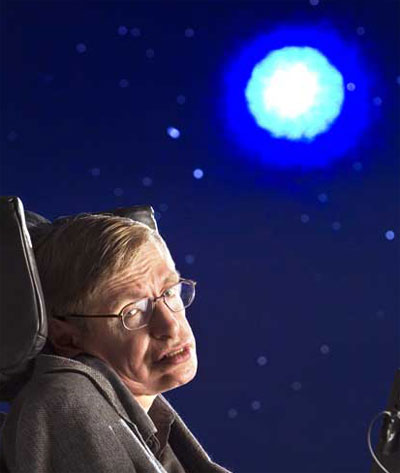
Stephen Hawking
What Goes In The Black Hole Stays In The Black Hole
By
James Trefil
Washington Post, September 7, 2008
Edited by Andy Ross
The Black Hole War
My Battle with Stephen Hawking to Make the World
Safe for Quantum Mechanics
By Leonard Susskind
If you must learn about black holes, you could do a lot worse than to pick
up this engagingly written book. Stanford physicist Leonard Susskind
provides a marvelous introduction to the subject that is both readable and
easy to understand. Or at least as easy as something involving the two great
20th-century advances in science can be.
The 20th century brought two
revolutions. The first, which dealt with objects moving near the speed of
light or having very large mass, was relativity, the brainchild of Albert
Einstein. The second revolution came when people starting thinking about
very small objects, such as the stuff inside the atom. The resulting theory
is called quantum mechanics and was developed by a small group of young
scientists, the most familiar probably being Werner Heisenberg.
With
increasing urgency over the past 50 years, theoretical physicists have tried
to tie these two great 20th-century advances together. So far, we have not
been successful. And this is where Susskind's "war" comes in, because it
looked as if there could well be a fundamental contradiction between the two
theories. At least that's what Stephen Hawking argued.
Remember that
a black hole is an object so compact and so massive that nothing, not even
light, can escape from it. Stuff can fall in, but nothing can come out. The
black hole forms a kind of nexus where both relativity and quantum mechanics
come into play.
In 1983, Hawking proved that black holes are not
eternal. In fact, over unimaginably long spans of time, they evaporate. And
that's when the "war" started, because if a black hole evaporates (and
everyone agrees that it will), what happens to all the information that was
carried by the stuff that fell in? Hawking argued that this information was
lost forever.
The problem is that one of the basic laws of quantum
mechanics is that information cannot be lost. Hawking argued that with the
material that evaporated from the black hole, the information simply
disappeared.
In the end, Susskind and his colleagues were able to
resolve this dilemma and, in the words of the subtitle, "make the world safe
for quantum mechanics." I won't spoil the book for you by telegraphing the
ending. Suffice it to say that it involves a tour through the whole arcane
menagerie of modern physics.
Chapter One: The First Shot
San Francisco, 1983
The ... initial skirmish took place in the attic
of Jack Rosenberg's San Francisco mansion. Jack, also known as
Werner Erhard,
was a guru, a supersalesman, and a bit of a con man. Prior to the early
1970s, he had been just plain Jack Rosenberg, encyclopedia salesman. Then
one day, while crossing the Golden Gate Bridge, he had an epiphany. He would
save the world and, while he was at it, make a huge fortune. All he needed
was a classier name and a new pitch. ...
I liked Werner. He was
smart, interesting, and fun. And he was fascinated by physics. He wanted to
be part of it, so he spent wads of money bringing groups of elite
theoretical physicists to his mansion. ...
The year was 1983. The
guests included, among other notables, Murray Gell-Mann, Sheldon Glashow,
Frank Wilczek, Savas Dimopoulos, and Dave Finkelstein. But for this story,
the most important participants were the three main combatants in the Black
Hole War: Gerard t'Hooft, Stephen Hawking, and myself.
Although I had
met Gerard only a few times before 1983, he had made a big impression on me.
...
But it wasn't Gerard whom I most remember from Werner's attic. It
was Stephen Hawking, whom I first met there. It's where Stephen dropped the
bomb that set the Black Hole War in motion. ...
Stephen claimed that
"information is lost in black hole evaporation," and, worse, he seemed to
prove it. If that was true, Gerard and I realized, the foundations of our
subject were destroyed. ...
On the blackboard was a Penrose diagram,
a type of diagram representing a black hole. The horizon (the edge of the
black hole) was drawn as a dashed line, and the singularity at the center of
the black hole was an ominous-looking jagged line. Lines pointing inward
through the horizon represented bits of information falling past the horizon
into the singularity. There were no lines coming back out. According to
Stephen, those bits were irretrievably lost. To make matters worse, Stephen
had proved that black holes eventually evaporate and disappear, leaving no
trace of what has fallen in. ...
What's so bad about losing a bit of
information inside a black hole? Then it dawned on us. Losing information is
the same as generating entropy. And generating entropy means generating
heat. The virtual black holes that Stephen had so blithely postulated would
create heat in empty space. Together with another colleague, Michael Peskin,
we made an estimate based on Stephen's theory. We found that if Stephen was
right, empty space would heat up to a thousand billion billion billion
degrees in a tiny fraction of a second.
AR Reading this book sounds like a pretty dumb way to try to catch up with some deep physics. As for Werner Erhard, I became acquainted with his works in London in 1985. A girlfriend had just "done" The Forum and liked it so much she persuaded me to do it too. It was quite a pleasant experience and I did not feel conned at all.

